
Decree of the Government of the ADR on the nationalization of public education and secondary schools
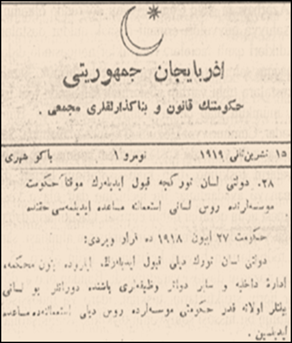 Language policy in Azerbaijan dates to the period of the Azerbaijan Democratic Republic. Until that time (either in the 19th century or especially in the early 20th century), prominent Azerbaijani intellectuals had expressed certain opinions and made assumptions about the native language, and the linguistic processes taking place in Azerbaijan. However, the official declaration of the Turkish language as the state language on June 27, 1918, just a month after the establishment of the Azerbaijan Democratic Republic, was the result of the direct influence of the national ideology defined in the late 19th century and early 20th century. Of course, the untiring struggle of intellectuals like Mirza Fatali Akhundzade, Ali bey Huseynzade, Mahammad Agha Shahtakhtli, Ahmad bey Aghayev, Jalil Mammadguluzade, Omar Faig Nemanzade, Firidun bey Kocharli, Mirza Alakbar Sabir, Uzeyir Hajibeyli for the literary, socio-political and ideological position of their native language for many years had provided a stimulus to the government of the Azerbaijan Democratic Republic to pay immediate attention to this issue. The decision of the government dated June 27, 1918, was made regarding the existing situation. Thus, according to that decision, the Russian language was allowed to be used in government institutions until those working in the judicial authorities, administrative management and other positions learn the state language at the appropriate level. That decision can be considered the first document on the use of the native language as the state language.
The first official document proclaiming the Azerbaijani (Turkish) language as the state language, besides playing a great historical role, laid the foundation for the formation of the national language policy in Azerbaijan and the correct ideological position in the interests of the nation. It should be noted that the decision of the Azerbaijani government was not just a declarative document. The issues arising from the adoption of the decision were periodically discussed at the parliamentary sessions, and language courses were organized for those who did not speak the Azerbaijani (Turkish) language. Besides, the ADR government allocated 351,000 manats from the state budget for that purpose.
The Azerbaijan Democratic Republic (ADR) considered education as a crucial area for implementing its language policy. In this context, on August 28, 1918, the ADR government adopted a resolution on the nationalization of public education and secondary schools. According to this resolution, tuition in all primary educational institutions was to be conducted in Azerbaijani. The Azerbaijani language was introduced as a compulsory subject with a workload of 3-4 hours per week in classes taught in Russian. During that period, the republic experienced a pressing need for national pedagogical personnel.
The biggest challenge in nationalization of education was shortage of teaching staff. Short term pedagogical courses were established in Ganja, Shaki and Zagatala in 1918 and 150 people were involved in those courses in order to meet the needs in teachers. The Government of Azerbaijan adopted a resolution on relocation of Teachers’ Seminary in Gori on June 22, 1918.
ADR Government set up a special commission with a view to compilation and publication of schoolbooks in the Ministry of Education. The textbooks “Turkish alphabet”, “New scientific calculation”, “The second year”, “New school”, “Literature lessons”, “Reading-book”, “Turkish garland”, “History” and “Basic algebra” were published. By the decree of September 18, 1919, Azerbaijani Parliament allocated one million manats to the Ministry of Public Education for the purchase of new books in Turkish language.
As a result of the arrangements made by the Government of Azerbaijan there were 637 primary schools and 23 secondary schools in the early 1919. There were 6 male and 4 female classical schools, 5 schools of natural sciences, 3 teachers’ seminaries (Baku, Ganja and Gazakh), 3 Saint Nina girls’ educational institutions (Baku, Ganja and Shaki), polytechnic and commercial schools. Teachers’ seminaries in Baku, Ganja and Gazakh, Saint Nina girls’ schools in Baku, Ganja and Shaki, also polytechnic and commercial schools operated in Baku.
In September 1919, male and female classical schools began their activity in Lankaran.
On September 11, 1919, by the decision of the Azerbaijani Government "Saint Nina" schools were renamed the first Baku national girls’ classical school, Ganja girls’ classical school and Shaki girls’ classical school. In 1919, the Ministry of Education introduced a bill to the Parliament on the opening of schools of natural sciences and teacher training schools in Baku, Shaki, Shusha, and Goychay, and the bill was passed.
In the summer of 1919, the Azerbaijani Government opened short term pedagogical courses for men and women in Baku, Ganja and Shaki, for men in Shusha, Gazakh, Gusar, Salyan and Zagatala in order to expand and deepen the education system in the country.
On July 23, 1918, by the decision of the ADR Government 50 teachers were invited from Turkey. They started their teaching activity in Azerbaijan in the early October, 1919.
The Ministry of Public Education established a commission for writing and publishing the textbooks in the Azerbaijani language. Textbooks and educational supplies were purchased from Turkey. One of the most important tasks of the Azerbaijan Democratic Republic was the organization of higher education in Azerbaijan and training of highly qualified national personnel. Baku State University was founded by the Parliament of the Azerbaijan Democratic Republic on September 1, 1919. Outstanding scientists were invited in order to provide professors and teaching staff for the university. One million manats were allocated for purchase of equipment and books.
By the decision of the Parliament 100 University entrants were sent to Germany, Italy, France and Turkey to study overseas. It was decided to send several students to Russian educational institutions as well. However, that plan was thwarted by the foreign military intervention and ongoing civil war.
During the republic, the decisions made concerning the language, alphabet, and education were of great importance for that period. Although the republic was able to maintain its existence for 23 months, the decisions taken during that period remained relevant in many issues related to language and education at a later period. The language policy launched regarding the Azerbaijani (Turkish) language continued even after the fall of the republic.
Recommended literature:
- Məmmədov, Aqşin. Azərbaycan Xalq Cümhuriyyəti dövrünün etnik mənzərəsi və dil siyasəti / A. Məmmədov; Azərbaycan Respublikasının Prezidenti yanında Strateji Araşdırmalar Mərkəzi.- Bakı: Strateji Araşdırmalar Mərkəzi, 2018.- 88 s.
- 1920-ci ilədək ali məktəblərdə oxumuş azərbaycanlılar: ensiklopedik soraq kitabı / tərt.-müəl. M. C. Mərdanov, Ə. Tahirzadə, elmi red. Y. Mahmudov. I cild: A.- Bakı: Təhsil, 2018.- 480 s.
- Nəzərli, Əzizə Ənvər qızı. Azərbaycan Cümhuriyyətində xalq təhsili: 1918-1920-ci illər: monoqrafiya / Ə. Ə. Nəzərli; tərc.: K. İsmayılov, Ə. Nəzərli; tərc. red. A. S. Rüstəmova; AMEA A.A. Bakıxanov adına Tarix İnstitutu.- Bakı: Xəzər Universiteti nəşriyyatı, 2018.- 240 s.
- İbrahimov, Elçin. Azərbaycan Xalq Cümhuriyyəti: dil məsələləri / E. İbrahimov; elmi red. K. Abdullayev ; AMEA Nəsimi adına Dilçilik İnstitutu.- Bakı: XAN nəşriyyatı, 2018.- 208 s.