
Gafur Mirzazadeh (Gafur Rashad) — Azerbaijani geographer, educator, teacher and translator
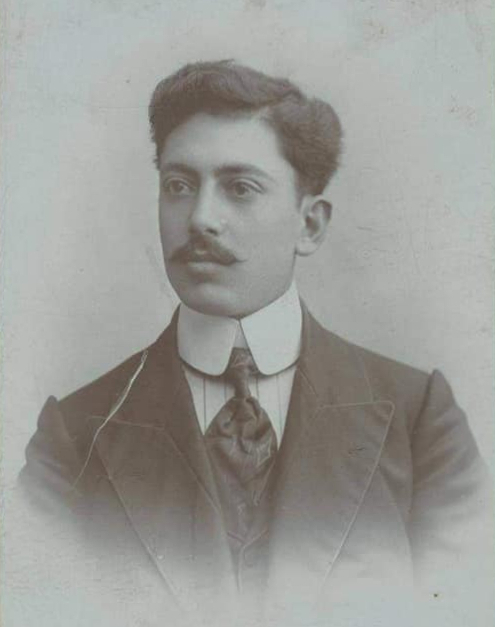 Gafur Alakbar oghlu Mirzazadeh (Gafur Rashad) is one of the prominent intellectuals distinguished for his multifaceted contributions to the history of enlightenment in Azerbaijan. As an educator, publicist, editor-publisher, translator, and geographer, he played an important role in the formation of the national education system, the development of textbooks, and the advancement of children’s literature in the early 20th century.
Born on 6 May 1884 in Shamakhi into the family of Alakbar, a poor and illiterate dyer, Gafur Rashad received his initial education at a mollakhana (traditional religious school) and, in 1894, enrolled in the city’s six-year school. The deterioration of his family’s financial situation threatened to interrupt his education; however, in recognition of his outstanding academic performance, the school administration decided to waive his tuition fees. After graduating from the school in 1901, Gafur began his teaching career due to limited financial means. He later continued his education, studying at the two-year Higher Pedagogical Institute from 1920 to 1922, and in 1923, he enrolled in the Faculty of Economics of the Azerbaijan Polytechnic Institute, graduating in 1927.
His teaching career began in 1902, when, before the age of 18, he was appointed as a teacher in the village of Lahij in the Shamakhi district. In the early years, due to the absence of a separate school building, classes were conducted under modest conditions. However, as local interest in education increased, a new school building was constructed, significantly improving the learning environment. As a result of Gafur Rashad’s efforts, the number of children enrolled in the school grew steadily, and an interest in literacy emerged even among the adult population. Taking this need into account, he organized evening courses and sought to promote education among broader sections of the population. Well read in Turkish, Persian, and Russian, Gafur Rashad regularly followed the journal “Molla Nasreddin”, first published in 1906, and read it to participants in the evening courses.
In 1907, at the invitation of the “Nəşr-Maarif” charitable society, Gafur Rashad moved to Baku, where he taught in teacher training courses and at various schools. In 1916, he was invited to teach the Azerbaijani language at Baku Real School No. 2, and two years later at Baku Real School No. 1. There, he worked alongside such prominent intellectuals of the time as Abdulla Shaig and Huseyn Javid, actively contributing to the development of national education. In 1919, his work as a geography teacher in the only national class at Baku Real School No. 1 stands as a clear example of his sustained efforts in the field of national education.
Gafur Rashad carried out systematic work to ensure the provision of textbooks to Azerbaijani schools and is recognized as a pioneer of the first systematic geography textbooks that laid the foundations of national geography instruction. His work in this field had a significant impact on the establishment of geography as an independent subject taught on a scientific basis in Azerbaijani schools. Between 1909 and 1943, he prepared and published a total of 18 textbooks and teaching materials, including “Geography of the Caucasus” (1910), “Elementary Geography” (1922), “General Geography” (1923), “Dictionary of Geographical Terms” (1923), “Economic Geography of the USSR” (1941), and “Practical Work with Maps” (1943), among others. In addition, the textbooks “Rahbari-Sarf,” prepared jointly with Mammad Sadiq Akhundov, and “Rahbari-Hesab,” co-authored with Abdurrahman Afandizadeh, were used in schools for many years. These works stood out for their clarity of language and precision of expression, marking a qualitative advance over earlier textbooks.
Gafur Rashad also made a significant contribution to the development of children’s press and literature. Together with Abdurrahman Afandizadeh, he founded the journal “Məktəb” (“School”)—the second children’s magazine in Azerbaijan, published from 1911 to 1920—as well as the printing house of the same name. The first issue of the journal was published on 29 November 1911. The journal “Məktəb” was not merely a children’s publication, but also served as an important intellectual platform contributing to the formation of national consciousness. With the participation of such intellectuals as Nariman Narimanov, Abdulla Shaig, Huseyn Javid, Abbas Sahhat, and Sultan Majid Ganizadeh, it published original works, translations, and popular science articles, thereby contributing to the development of a rich tradition of children’s literature. The journal played a significant role both in the emergence of a new generation of writers and in the upbringing of children in the spirit of national and moral values.
Gafur Rashad was also active as a journalist, publicist, and publisher. He published articles on social issues in the press and, in his work “Ayineyi-millat” (The Mirror of the Nation), published in 1908, advanced ideas of national awakening and social engagement. As part of his publishing activity, he collaborated with Mirza Abbas Abbaszadeh, supported efforts aimed at the education of women, and took part in the publication of the book “Arvad Ağısı” (A Woman’s Lament). In the field of translation, he translated and adapted works by Leo Tolstoy and P. N. Polevoy into Azerbaijani, making them accessible to readers.
Gafur Rashad’s intellectual outlook was enriched by extensive life experience and observation. Over many years, he traveled to various regions of Azerbaijan, as well as to Central Asia, Siberia, Georgia, Ukraine, and Belarus. This experience enabled him to present events and processes in his geographical works in a dynamic developmental context. In his work “Geography of Azerbaijan,” he particularly emphasized the importance of presenting geographical data not merely as statistics, but in conjunction with processes of development.
In the final years of his life, alongside his teaching activities, he worked as a research fellow at the Azerbaijan State Scientific Research Institute of Schools.
Gafur Alakbar oghlu Mirzazadeh passed away on 27 November 1943. His multifaceted activity and rich legacy continue to be relevant in the history of Azerbaijani education and culture, and remain of great importance for the development of national pedagogical thought.
Recommended literature:
- Namazova, Sevinc Təhməz qızı. Pedaqoji irsimizdən : Qafur Rəşad Mirzəzadə: [monoqrafiya] /S. T. Namazova ; elmi red. F. A. Rüstəmov. - Bakı: Elm və təhsil, 2014. - 195 s.
- Yüzbaşov, Rəmzi Mövsüm oğlu. Məşhur coğrafiyaşünas Qafur Rəşad Mirzəzadə /R. M. Yüzbaşov ; elmi red. Q. K. Gül ; red. M. Əbdürrəhimova ; rəss. A. Rüstəmov. - Bakı: s.n., 1968. - 31 s.