
State Statistical Committee presents statistical compendiums to Presidential Library
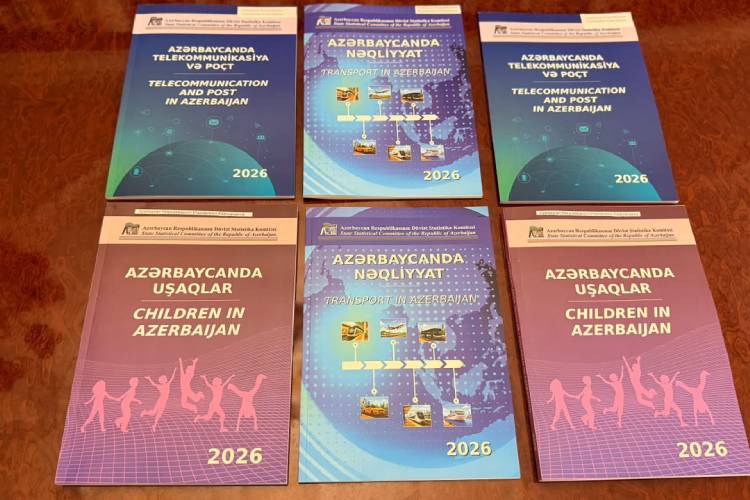
The State Statistical Committee of the Republic of Azerbaijan has donated the statistical compendiums entitled “Telecommunications and Postal Services in Azerbaijan”, “Transport in Azerbaijan”, and “Children in Azerbaijan” to the Presidential Library.
The statistical compendium “Telecommunications and Postal Services in Azerbaijan” provides fundamental indicators concerning information, communication, and postal services; the developmental dynamics of these sectors; the number and total capacity of automatic telephone exchanges (ATEs); the number of fixed-line telephones; and supplementary data regarding telephone communications. The indicators are disaggregated by urban and rural areas, as well as by economic regions. In addition to detailing the number of employees in communication and postal enterprises, their average monthly nominal wages, and other relevant metrics, the publication incorporates core statistical data on the communications sector of CIS countries for comparative analysis. The compendium concludes with methodological explanations of the primary concepts and indicators.
The statistical compendium “Transport in Azerbaijan” presents key indicators that characterize the current state and developmental dynamics of the national transport sector. The publication encompasses data on freight volume, freight turnover, passenger traffic, and passenger turnover across various modes of transport. Furthermore, it details revenues derived from transport activities, transportation expenditures, investments allocated to the sector, commissioned fixed assets, and the workforce size and remuneration within transport enterprises. The publication also provides regional data on motor transport and road infrastructure, alongside statistical indicators of the transport sectors of several global economies for comparative purposes. Following the tabular data, concise methodological explanations regarding the compilation of the statistical indicators are provided.
The statistical compendium “Children in Azerbaijan” covers statistical data spanning the period from 2000 to 2025. The publication features data on the child population size, birth and mortality rates, and natural increase, alongside statistics on education and culture, therapeutic and preventive healthcare services, social protection, morbidity and mortality causes, and juvenile delinquency. Additionally, it presents metrics relating to preschool and general education institutions, pediatric diseases, and other relevant indicators. The data are further disaggregated by economic regions and administrative territorial units.
These statistical compendiums facilitate access to fundamental indicators in the realms of telecommunications, postal services, transport, demography, and the social sector, thereby enabling comparative analyses across diverse timeframes and geographic areas. The statistical data documented in these publications serve as a valuable resource for empirical research and scholarly investigations, the professional activities of specialists, and the preparation of media content, while also allowing a broad readership to familiarize themselves with comprehensive information across these diverse disciplines.