
Eminent poet Mohammad-Hosseyn Shahriyar
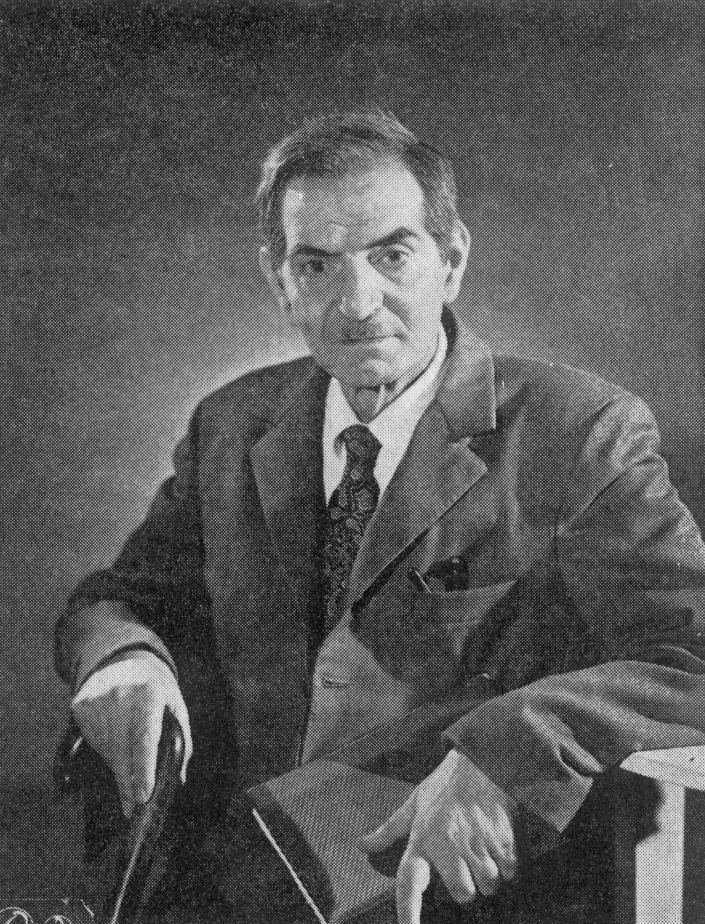 Mohammad-Hosseyn Shahriyar was born in 1906 in the Baghmesha district of Tabriz, into the family of Haji Miragha Khoshginab, a jurist. His father, while practicing law to support the family, played a significant role in his upbringing through his own love of poetry and music, which deeply influenced the young Shahriyar. His literary inclination emerged early: by age seven, he composed poetry in Azerbaijani, and by nine, in Persian, nurtured by his father’s extensive library. After receiving his preliminary education in a Tabriz madrasa, Shahriyar spent summer vacations in Khoshginab, at the foothills of Mount Heydarbaba, where he advanced his studies under the guidance of Molla Ibrahim. In 1913, while studying at Tabriz’s Mohammadiyya School, his first poem was published in the journal “Adab” (Ethics). After completing his secondary education in Tabriz, he gained admission to the Faculty of Medicine at the University of Tehran in 1922.
By the mid-1920s, Shahriyar began gaining recognition as a young poet. During this period, he fell in love with a girl named Suraiya but faced opposition from her affluent relatives. Their objections ultimately led to Shahriyar’s exile from Tehran to Nishapur, forcing him to abandon his medical studies prematurely. During his years of exile, he held administrative posts in various Iranian cities, including Mashhad. By the mid-1930s, he returned to Tehran and secured employment at a bank. Following his father’s death in 1934, he composed an elegiac poem, while his mother’s passing inspired the profoundly mournful work “Ey vay maderim!” (“Alas, My Mother!”). Financial hardships continued to plague him throughout this era.
Shahriyar’s poetic fame initially emerged under his birth name, Seyid Mohammad-Hosseyn Behjat Tabrizi. However, upon deciding to adopt a pen name, he opened Hafez’s “Bakhtnameh” and selected “Shahriyar” (King’s Companion), a choice that would leave an indelible mark on Persian literary history. His first poetry collection “The Voice of God” was published in Tehran with prefaces by eminent scholars including Malek al-Sho’ara Bahar, Sa’id Nafisi, and Peyman Bakhtiyari - demonstrating the early critical recognition of his work. Shahriyar’s oeuvre spans classical forms (ghazals, qasidas, masnavis, qit’as, and ruba’is), with themes of Azerbaijani identity, patriotism, and libertarian ideals constituting their central motifs.
In the early 1950s, Shahriyar returned to Tabriz and married Aziza khanim, an elementary school teacher, in 1953. While this marriage brought him some stability, his family endured prolonged financial hardships for many years. Shahriyar’s crowning literary achievement remains “Heydarbabaya salam” (“Greetings to Heydarbaba”), a masterpiece of 20th-century Azerbaijani poetry. The poem consists of two parts: the first section (77 stanzas) was composed in Tehran, and the second (48 stanzas) in Tabriz. Through exquisite depictions of natural beauty, rustic simplicity, human joys and sorrows, and folk traditions, the work stands as Shahriyar’s most significant artistic testament to his homeland and the spirit of his people.
Following the fall of Iran’s monarchy in 1979, the new government implemented measures to improve Shahriyar’s living conditions, providing him with a comfortable residence and a state pension. However, the physical and psychological hardships he endured since youth had already severely compromised his health. The sufferings of his exile years and prolonged material deprivations led to recurrent illnesses, requiring extended hospital and home care. On September 18, 1988, he succumbed to pneumonia and heart failure at Tehran’s Mehr Hospital. In accordance with his will, his remains were transported to Tabriz and interred at the “Maqbarat al-Shu’ara” (“Poets’ Mausoleum”) in Surkhab.
Shahriyar’s poetic legacy significantly enriched both Azerbaijani and Persian literary traditions. His works - particularly “Heydarbabaya salam” (“Greetings to Heydarbaba”) - embody timeless values of national identity and reflect the collective spirit of his people.
Recommended literature:
- Ələkbərli, Faiq Qəzənfər oğlu. Azərbaycan türk fəlsəfi və ictimai fikir tarixi: XIX-XX əsrlər : monoqrafiya / F. Q. Ələkbərli ; elmi red. Z. M. Şabanov ; Azərbaycan Əmək və Sosial Münasibətlər Akademiyası. III hissə. - Bakı : Elm və təhsil, 2021. - 684 s.
- Məhəmmədi, Məsiağa Əhməd oğlu. Şəhriyar və zəmanəmiz / M. Ə. Məhəmmədi ; red., ön sözün müəl. Q. F. Bayramov. - Bakı : ADMİU, 2015. - 80 s.
- Gedikli, Yusif. Şəhriyar və bütün türkcə şeirləri / Y. Gedikli ; türkcədən tərc. X. Xalid ; elmi red. F. Gedikli. - Bakı : YOM Yayınları, 2007. - 192 s.
- Şəhriyar, Məhəmmədhüseyn. Seçilmiş əsərləri / M. Şəhriyar. - Bakı : Elm, 2000. - 492 s.
- Quliyev, Elman Hilal oğlu. Seyid Məhəmmədhüseyn Şəhriyar / E. H. Quliyev ; elmi red. A. Hacıyev. - Bakı : Mütərcim, 1999. - 180 s.