
Saib Tabrizi — one of the most renowned figures of classical Azerbaijani literature
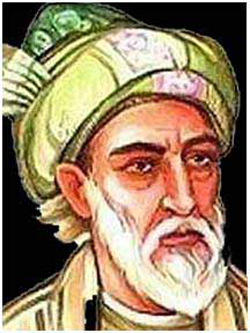 Among the most eminent poets of the seventeenth-century East stands Saib Tabrizi, the author of exquisite verses in both Azerbaijani and Persian. Mirza Mahammad Ali Saib Tabrizi was born in 1601 in the city of Tabriz, where he also received his elementary education. His father, Mirza Abdurrahim, was a merchant who, according to the noted biographer Nasrabadi, enjoyed great respect. His paternal grandfather, Shams al-Din Mahammad Tabrizi, was a highly skilled calligrapher, known throughout the Eastern world by the epithet “Qalami-shirin” (“Sweet Pen”).
At the end of the sixteenth century, during the reign of Shah Tahmasib, Tabriz was occupied by the Ottomans. After the city’s liberation, Shah Abbas relocated many of its inhabitants to Isfahan, among them Saib’s father. It was in Isfahan that Saib continued his education and poetic activity. He studied under the prominent scholars Kashi and Shafai, and by the time he completed his studies, he was already recognized in Isfahan as a learned intellectual and a talented poet. Following the traditions of the age, he pursued further education through travel. He undertook pilgrimages to Mecca and Medina, then traveled to Türkiye, where he became acquainted with distinguished poets and scholars, engaging in creative discussions. Soon after returning to Isfahan, where he was received coldly, Saib departed for India in 1625, stopping first in Kabul. In Kabul, the ruler Mirza Ahsanullah Nawwab—known in literary circles by the pen name Zafarkhan—welcomed Saib warmly as a close friend and hosted him in his court. In 1630, Zafarkhan brought Saib with him to the court of the Mughal ruler Shah Jahan (later renowned worldwide for erecting the Taj Mahal in honor of his wife). At this court, Saib met the eminent physician and poet Masihi, author of the celebrated Azerbaijani poem “Varqa and Gulsha,” who was serving as the Shah’s physician. Although many biographers later considered Masihi to be Saib’s pupil, their relationship was one of enduring friendship and mutual influence. Saib highly valued Masihi’s work and, after his friend’s death, became one of the first compilers of his “Divan”. According to Mirza Tahir Nasrabadi, Saib owned ten copies of Masihi’s “Divan”.
Saib’s father followed him to India, seeking permission to take him back to Isfahan. In 1633, Zafarkhan, then governor of Kashmir, fulfilled Saib’s desire to return home. Yet for various reasons, the poet could not remain in Isfahan long and set out on further travels, visiting Mashhad, Qom, Qazvin, Yazd, and Ardabil before returning once again to Isfahan. This time, under Shah Abbas II (1642–1666), Saib was received with honor and invited to the royal court, where he was appointed “malik al-shu‘ara” (chief of poets). There, he composed lyrical ghazals (lyric poem) and qasidas (ode).
Saib Tabrizi is credited with founding the new poetic trend that Iranian scholars have termed the “Isfahan style,” while in India, he is regarded as the founder of the Persian “Indian school” of poetry. During his time at court, he composed qasidas and epic works praising the Shah’s military achievements. Among these, the poem “Qandaharnama” occupies a special place for its artistic value, dedicated to Shah Abbas II’s Afghan campaign and his conquest of Qandahar in 1649.
After Shah Suleyman (1666–1694) ascended the throne, Saib’s position at court began to deteriorate, compelling him to withdraw. He dedicated the last decade of his life to organizing and systematizing his works, arranging his poems thematically into collections such as “Mir‘at al-jamal” (“Mirror of Beauty”), “Arayish-i nigar” (“Adornment of the Beloved”), and “Wajib al-hifz” (“Obligatory to Preserve”).
Saib left behind a vast poetic legacy. Some researchers estimate his corpus at approximately 300,000 couplets. The eminent Azerbaijani scholar Mahammad Ali Tarbiyat, in his book “Prominent Figures of Azerbaijan”, noted that he himself had seen Saib’s “Divan” comprising 120,000 couplets (not including longer poems).
Saib Tabrizi died in 1677 in the city of Isfahan, where he was also laid to rest.
Recommended literature:
- Xudiyev, Nizami Manaf oğlu. Seçilmiş əsərləri / N. M. Xudiyev. VIII cild : Xalqın tarixi haqqı: dilimiz, varlığımız / elmi red. T. H. Hacıyev. - Bakı : Elm və təhsil, 2014. - 571 s.
- Azərbaycan klassik ədəbiyyatından seçmələr: 3 cilddə. III cild : XVII-XVIII əsrlər Azərbaycan şeiri / tərt. C. V. Qəhrəmanov ; red. A. M. Dadaşzadə. - Bakı : Şərq-Qərb, 2005. - 456 s.
- Təbrizi, Saib. Seçilmiş əsərləri / S. Təbrizi ; fars dilindən tərc., tərt. B. Azəroğlu, red. M. M. Adilov, bur. məsul Ə. Güləliyev. - Təkrar nəşr. - Bakı : Öndər nəşriyyat, 2004. - 256 s.