
Prominent educator and public figure Habib bey Mahmudbeyov
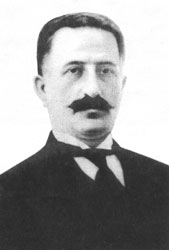 Habib bey Haji Ibrahimkhalil oghlu Mahmudbeyov, who made exceptional contributions to the formation of Azerbaijani enlightenment, was born on July 29, 1864, in Shamakhi. Descended from the Shirvan nobility, Habib bey’s great-grandfather, Haji Sadig, served as the renowned treasurer of Nadir shah, while his father, Haji Ibrahimkhalil bey, was recognized as one of Shamakhi’s distinguished and respected intellectuals.
At the age of eight, Habib bey received his primary education at a local school under the guidance of scribe Mirza Huseyn, later enrolling in a city school. However, the devastating earthquake of 1872 in Shamakhi disrupted his education, forcing him to move to Baku with his family. There, he continued his studies at a Realschule (secondary school), completing the sixth grade. In 1883, together with his enlightened friend Sultan Majid Ganizadeh, he traveled to Tiflis and enrolled in the Alexandrov Teachers’ Institute. At the time, this institute was considered one of the leading centers of higher pedagogical education in the South Caucasus, and the knowledge acquired there formed the intellectual foundation of Mahmudbeyov’s future enlightenment activities. Upon graduating from the institute in 1887, Habib bey returned to Baku, and together with S.M. Ganizadeh, he established Azerbaijan’s first private Russo-Muslim school by the end of that same year. The founding of this school marked a significant event in the history of national education. Instruction was conducted in the native language, as well as in Russian and Persian, covering subjects such as mathematics, geography, history, and Islamic law. The school quickly gained widespread recognition, and by 1891, it began receiving state funding. This not only demonstrated the government’s growing interest in education but also proved the effectiveness and social necessity of Mahmudbeyov’s educational model. His initiative later spurred the establishment of similar schools in various regions of Azerbaijan, laying the first pillars of the national education system.
Not confining his enlightenment activities solely to establishing schools, Habib bey also played a significant role in the development of culture, particularly theater. During the formative period of national theater in Baku in the 1880s, he led, together with Sultan Majid Ganizadeh and Najafgulu Valiyev, the organization of a permanent theater troupe. This troupe featured prominent actors such as Huseyn Arablinski, Jahangir Zeynalov, Mirzagha Aliyev, Abulfat Vali, and Muhammad Alavandi.
In 1896, Habib bey Mahmudbeyov, together with S.M. Ganizadeh, I. Melikov, and others, established the Russo-Muslim library. At that time, library work was of great importance for the development of reading culture, one of the fundamental pillars of enlightenment. Subsequently, in 1897, in collaboration with S.M. Ganizadeh and A. Akhundov, he founded a publishing company in Baku, which primarily organized the printing of textbooks, children’s literature, and literary works in Azerbaijani and Russian. Habib bey was also among the founders of the Narimanov Library and supported its development.
In the early 20th century, Habib bey Mahmudbeyov also actively engaged in socio-political activities. As a member of the Baku City Duma’s school commission, he participated in decision-making processes related to education and played a crucial role in organizing and conducting the first congress of Azerbaijani teachers in 1906.
Following the establishment of Soviet power in Azerbaijan in 1920, Habib bey Mahmudbeyov continued his educational mission while adapting to the new political circumstances. He actively participated in the creation of the Azerbaijan Higher Pedagogical Institute alongside Fateli Rzabeyli and Ali Jafarov, serving both as deputy director and as a teacher of Russian language and literature. Later assuming the position of director, he simultaneously contributed to expanding education’s social reach through the organization of evening courses. These courses operated in the building under his leadership, which later became known as Schools No. 18 and 240. Thus, Habib bey worked tirelessly to broaden education not only in terms of content and form but also in its social accessibility.
Having devoted his entire life to public enlightenment and the development of national consciousness, Habib bey Mahmudbeyov passed away in Baku in 1927.
Recommended literature:
- Vəzirov, Haşim bəy.Bakıdakı rusi-müsəlmani məktəblərin iyirmi beş illik yubiləsi münasibəti ilə /H.Vəzirov; Tərtibçilər: Ə.Tahirzadə, İ.Calallı. - Bakı: Nurlar, 2004. - 46 s.
- XIX əsr-XX əsrin birinci yarısı Azərbaycan maarifçiliyi və maarifçiləri: məqalələr toplusu /AMEA, Milli Azərb. Tarixi Muzeyi ; elmi red. N. Vəlixanlı ; ön söz. F. Cabbarov. - Bakı: Ziya, 2013. - 143 s.