
Renowned architect of Baku Józef Gosławski
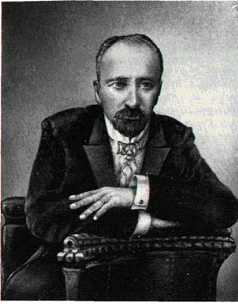 Józef Vikentyevich Gosławski was born in 1865 into a noble family in Warsaw, Poland. After moving to Saint Petersburg in his youth, Gosławski pursued studies in civil engineering and architecture, successfully graduating in 1890 from the Saint Petersburg Institute of Civil Engineers named after Nicholas I. Recognizing his exceptional talent and technical abilities, he was subsequently assigned to the Technical Construction Committee of the Ministry of Internal Affairs of the Russian Empire.
Gosławski's first arrival in Baku dates to 1891, when he was dispatched to supervise the construction of the Alexander Nevsky Orthodox Church (later known as the "Golden Church"), designed by architect R.R. Marfeld and located near the historical Inner City (Icheri Sheher). As the construction site was situated on an ancient Muslim cemetery and had experienced significant delays, Gosławski was appointed to assist Marfeld. Under his adept organizational and technical supervision, construction accelerated rapidly, resulting in the project's successful completion. The church, inaugurated in 1898, became known as the largest Orthodox church in the Caucasus at the time. During the Soviet period, the church was demolished; currently, schools numbered 189 and 190 occupy its site.
Gosławski’s demonstrated competence led to greater responsibilities. In 1892, at only 27 years old, he was appointed the chief architect of Baku. Over the course of twelve years in this position, projects bearing his signature have significantly influenced the city’s architectural identity. During the rapid urbanization of Baku in the late 19th and early 20th centuries, he designed numerous residential, public, and industrial buildings, personally overseeing many constructions.
One of Gosławski’s earliest major projects was a city palace commissioned by Haji Zeynalabdin Taghiyev. Construction began in 1892 and concluded ten years later, in 1902. Integrating Eastern architectural elements with European classical style, this building currently houses the National Museum of History of Azerbaijan. This project marked the beginning of a long-term collaboration with Taghiyev.
In subsequent years, he designed Taghiyev’s two-story residence on Pochtoviy Street (now H.Z. Taghiyev Street, 1893–1895), his villa in Mardakan (1893–1895), a textile factory in Zigh village (1896–1899), a Muslim girls’ school (1898–1901), and the Taghiyev Theater (1899–1904). Taghiyev not only commissioned these projects but also financially supported other initiatives by Gosławski, including the construction of the main building of the Baku Technical School (currently Azerbaijan State Oil and Industry University).
Gosławski’s architectural contributions were not limited to private commissions; he also authored various significant public and administrative buildings. Among these is the Baku branch of the Imperial Russian Technical Society on Nizami Street, constructed in 1899. In 1902, he designed a private residence for Teymur bey Ashurbeyov. These buildings reflect Gosławski’s ability to successfully synthesize classical European architecture with local traditions.
His final project was the administrative building for the Baku City Duma. Executed in Baroque style, the construction proceeded in phases between 1900 and 1904. The building’s monumental volume and intricate decorative elements quickly established it as one of Baku's most iconic architectural landmarks. Unfortunately, Gosławski could not complete this project due to his deteriorating health from tuberculosis, and passed away in Baku in 1904 at only 39 years old. His compatriot, architect Józef Płoszko, completed the project, and the building was inaugurated in 1912. Today, it houses the Baku City Executive Authority.
Though his life was brief, Gosławski's twelve productive years in Baku profoundly reshaped the city’s architectural landscape, introducing European classical aesthetics into its urban silhouette. His work was distinguished not only by technical excellence but also by contextual sensitivity and aesthetic refinement. Beyond the city center, he executed numerous projects in surrounding villages and settlements.
Gosławski’s architectural legacy has received recognition from both the Azerbaijani state and the public. On May 31, 2019, President Ilham Aliyev and Polish President Andrzej Duda unveiled a commemorative plaque in Baku dedicated to Polish architects Józef Gosławski, Kazimierz Skórewicz, Józef Płoszko, and Eugeniusz Skibiński. Additionally, a street in the city's historic district was named "Polish Architects" to honor their contributions.
Today, Gosławski’s architectural creations remain symbolic landmarks that embody the city’s history. He is remembered not only as a figure of his era but as one of the distinguished names in the broader history of Azerbaijani architecture.
Recommended literature:
- Fətullayev-Fiqarov, Şamil Seyfulla oğlu. İ.V. Qoslabski - "Qafqazlı Rastrelli" = И.В. Гославский - "Кавказский растрелли" / Ş. S. Fətullayev-Fiqarov ; layihənin rəh. E. Ə. Qasımzadə ; Azərbaycan Respublikasının Memarlar İttifaqı. - Bakı : Şərq-Qərb, 2013. - 72 s.
- Fətullayev-Fiqarov, Şamil Seyfulla oğlu. Bakı memarları XIX əsrin sonu-XX əsrin əvvəlində /Ş. S. Fətullayev ; layihə rəhbəri E. Qasımzadə ; Azərb. Resp. Memarlıq İttifaqı. - Bakı: Şərq-Qərb, 2013. - 293 s.
- Fatullayev-Figarov, Shamil Seyfulla oghlu. J. V. Goslavsky- "The Caucasian Rastrelli" /Sh. Fatullaev-Figarov ; design N. Novruzov ; Union of Architects of Azerbaijan Republic. - Baku: Sharq-Qarb, 2013. - 67 р.