
The first Azerbaijani military pilot, Farrukh agha Gayibov
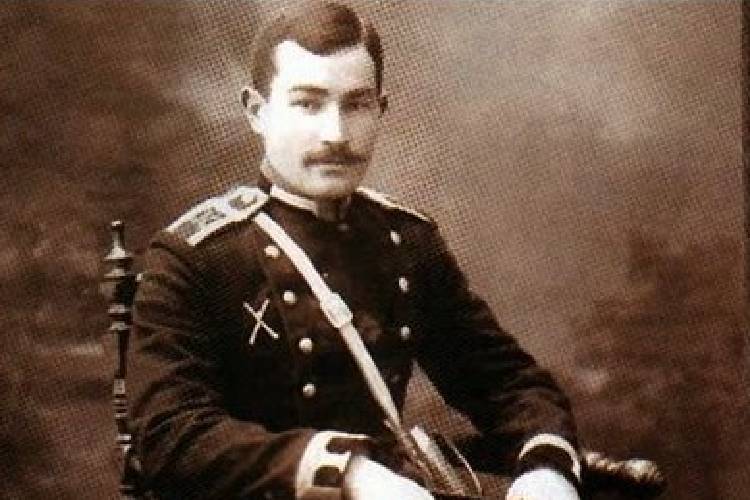 Farrukh agha Mammadkarim agha oghlu Gayibov was born on October 2, 1891, in the village of Ashagi Salahli in the Gazakh district. His father, Mammadkarim agha, was a military professional and the father of four children. He served as a cadet in the fourth Muslim platoon of the Caucasian Life Guards Convoy Squadron, named after His Majesty the Emperor. On July 27, 1877, he was promoted to the rank of ensign by the emperor in recognition of his many years of dedicated service in the regular army. In the subsequent years, Mammadkarim agha Gayibov held positions as the chief of court in the Gazakh and Yelizavetpol districts, as well as the field chief of the police bailiff in the Javanshir and Yelizavetpol (now Ganja) provinces. On August 30, 1894, he received the Order of Saint Stanislaus, third degree, for his outstanding service.
Farrukh agha lost his father at a young age and was raised by his uncle, Samad agha Gayibov, a notable educator of the time. He completed his education at a five-grade "Russian-Azerbaijani school" in his hometown of Salahli and subsequently attended the Tiflis Cadet Corps, following the recommendation of General Aliagha Shikhlinski. After graduating with honors from the Tiflis Cadet Corps on June 16, 1910, he enrolled in the three-year Constantine Artillery School in St. Petersburg. At the school, he demonstrated his intelligence, keen eye for measurements, and courage, earning first prize for his proficiency in cannon shooting. This award, a gold watch produced by the Swiss company Paul Buhré, features the engraving "Junker Farrukh agha Gayibov, 1913" on its back.
Second Lieutenant Farrukh agha Gayibov graduated with honors from the Constantine Artillery School and served in the 39th Artillery Brigade in Alexandropol as of August 6, 1913. Upon the outbreak of World War I, he was assigned to the Eleventh Aviation Corps on the Western Front.
On September 12, 1916, the Ilya Muromets military aircraft was assigned a new combat mission—to deliver a heavy blow to the enemy by bombing the positions of German military forces near the village of Baruny, which is now in Belarus territory. Although Farrukh agha lost his life during this mission, which was the last for our 25-year-old compatriot, he gained immortality for his bravery. Encountering four German fighters in the air, Gayibov's plane engaged in an unequal fight with the enemy. The "Ilya Muromets" plane, which shot down three German fighters, crashed to the ground due to the damage it sustained. Afterwards, the fourth German plane also crashed, unable to maintain control because of the fire from Gayibov.
The Germans, observing the battle with a different balance of forces, were impressed by the courage of our pilot. Despite being enemies, they recognized the bravery displayed by the crew of the "Ilya Muromets" aircraft. They honored them with burials similar to their own soldiers, even firing volleys at the pilots' graves. The heroism exhibited by Lieutenant Gayibov received considerable attention in the press of Tsarist Russia in 1916, as well as in German newspapers.
During his brief life, Farrukh agha demonstrated remarkable heroism. He was awarded the third class "Order of Saint Stanislaus" (with swords and ribbon) on November 8, 1915, followed by the fourth class "Order of Saint Anna" (with the inscription "For Bravery") on December 14 of the same year. In 1916, he received the second class of the "Order of Saint Stanislaus" (with swords and ribbon), and on January 26, 1917, he was honored with the second class "Order of Saint Anna" (with swords). On March 14, 1917, he was awarded the third class of the "Order of Saint Anna" (with swords and ribbon), and on March 25, 1917, he received the fourth class "Order of Saint George."
Although the burial place of Farrukh agha Gayibov was unknown for a long time, researchers of World War I history N. Y. Markov, V. V. Prikhach, and A. M. Bumay discovered the grave in the restored German cemetery near the village of Baruny.
Recommended literature:
- Nəzirli, Şəmistan Əmiraslan oğlu. Azərbaycanın ilk hərbi təyyarəçisi Fərrux ağa Qayıbov / Ş. Ə. Nəzirli; tərt. O. Bədəlov. - Bakı : Azer-Globe, 2007. - 40 s.
- Şahbazov, Atamalı. Azərbaycan Xalq Cümhuriyyəti ordusunun zabit və hərbi məmurları : tarixi oçerklər / A. Şahbazov ; ön sözün müəl. M. S. Süleymanov ; Azərbaycan Respublikası Silahlı Qüvvələrinin Hərbi Akademiyası. - Bakı : Maarif, 2020. - 816 s.