
1st Congress of Azerbaijani Women
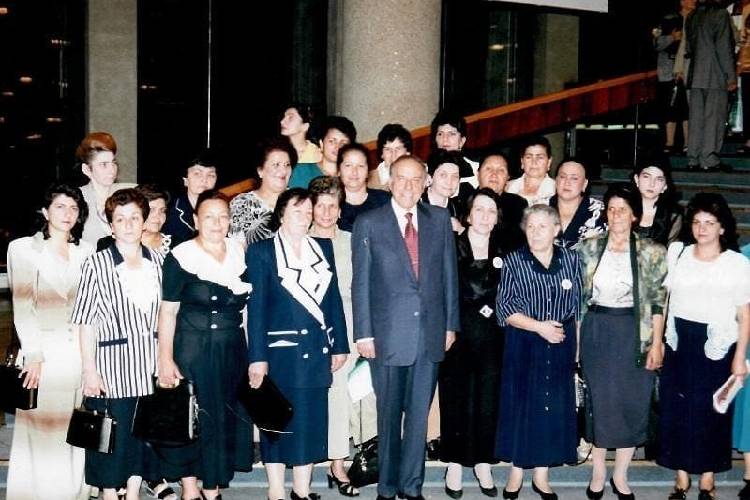 The first Women's Congress in the independent State of Azerbaijan took place on September 14, 1998. This event marked a new phase in the women's movement in our country, initiated by the Great Leader Heydar Aliyev. One of the key aspects of his state policy has been the protection of women's rights and freedoms, their representation in socio-political life, and public administration, as well as ensuring their equal rights in all areas. To support these goals, on January 14, 1998, Heydar Aliyev signed a decree establishing the State Committee on Women's Issues of the Republic of Azerbaijan. Another decree issued on the same day, titled "On Measures to Increase the Role of Women in Azerbaijan," instructed the Cabinet of Ministers to propose ways to enhance women's participation in the country's political, social, economic, and cultural life. Consequently, the First Congress of Azerbaijani Women was held on September 14, 1998. This initiative by Heydar Aliyev became a turning point in promoting social and cultural progress for Azerbaijani women and increasing their involvement in socio-political affairs. Since then, congresses of Azerbaijani women have been convened every five years, and these gatherings are regarded as one of the most significant and large-scale initiatives in the state's women's policy.
Throughout history, the issue of protecting women's rights and freedoms has manifested in various forms, particularly in Tsarist Russia, the Azerbaijan Democratic Republic (ADR), and the Soviet era. During the period of Tsarist Russia, women's rights and freedoms were highly restricted. A significant reason for this limitation was the prevailing Sharia system, which imposed serious obstacles to women's freedoms. During the Azerbaijan Democratic Republic, an important turning point occurred for women. For the first time in the East, women gained the right to vote and be elected, and they began actively participating in socio-political life. This development is considered a crucial milestone in improving the legal and social status of Azerbaijani women. During the years of Soviet rule, several legislative initiatives were introduced to enhance women's participation in the workforce and their integration into social life. One of the key objectives in the 1920s was to actively involve Azerbaijani women in public affairs and encourage their engagement in economic, social, and cultural activities. Between 1920 and 1922, over 20 decrees and resolutions were enacted addressing women's issues. As a result of these initiatives, women gained political and economic rights, including the right to participate in government bodies and the right to receive equal pay for their work and education.
The first Constitution of the Azerbaijan SSR, adopted in May 1921, granted extensive rights for women. A significant event in the history of the country’s women’s movement was the Congress of Azerbaijani Women held in Baku in February of that same year. This was the first large-scale gathering of Azerbaijani women, with 1,188 delegates in attendance. The primary goal of the congress was to increase the participation of working women in Azerbaijan and to organize the activities of women's departments across various districts.
The tradition of holding women's congresses in Azerbaijan dates back to the Soviet era, with events held in 1921, 1957, 1967, and 1972. These congresses created opportunities for Azerbaijani women to participate more actively in social, cultural, socio-political, and economic life, which contributed to the development of the women’s movement and its gradual pursuit of a more independent direction. However, like the women's movement as a whole in the Soviet Union, these congresses operated within a strict ideological framework. State ideology utilized official discourse as a means to control gender relations and the women's movement. Another characteristic of the women's movement was that it did not emerge as an independent initiative but rather as an integral part of broader national social projects.
After Azerbaijan regained its independence in 1991, the role of women in the development of civil society and the establishment of an independent state began to grow. Significant efforts were made to protect women's rights in independent Azerbaijan. The country committed to ensuring gender equality by joining international agreements, including the 1952 UN Convention on the Political Rights of Women on August 4, 1992, and the UN Convention on the Elimination of All Forms of Discrimination against Women on June 30, 1995.
In 2001, Azerbaijan joined the UN Development Fund for Women’s regional awareness campaign, "Life Without Violence," making international commitments to eliminate violence against women and promote gender equality.
Azerbaijan has actively collaborated with numerous international organizations and signed significant conventions, while also making considerable strides in protecting women's rights and freedoms within the country. The adoption of laws such as "On Guarantees of Gender (Men and Women) Equality" and "On Domestic Violence," along with important amendments to the Family Code, serve as clear examples of these efforts.
Under the leadership of National Leader Heydar Aliyev, our independent state experienced a significant evolution in the women’s movement. The nature of the Women’s Congresses underwent a qualitative change during this period. The Great Leader consistently emphasized the importance of women’s active participation in socio-political processes and their representation in state and administrative structures. He envisioned a future where Azerbaijani women, whose influence and roles in society were on the rise, could live free, prosperous, and dignified lives.
The decree of Heydar Aliyev, the National Leader of the Azerbaijani people, titled "On the Implementation of the State Women's Policy in the Republic of Azerbaijan," highlights the significant role of women in our society. It states: "With their will and courage, purity and loyalty, Azerbaijani women have played an exceptional role in the life of our society and in shaping the national and spiritual values of our people."
The consistent implementation of the state women's policy established by the Great Leader Heydar Aliyev has enabled Azerbaijani women to become active and influential members of society. Today, they have a voice and play an essential role in our country's development and the shaping of its international image.
Recommended literature:
- Heydər Əliyev və dövlət qadın siyasəti: fərmanlar, sərəncamlar, nitqlər, təbriklər, məlumatlar 1969-1982, 1993-2003 /layihənin rəhbəri və ön sözün müəl. H. Hüseynova, tərt.ed. S. Qəhrəmanova, T. Əhmədov; red. N.Rüstəmli. - Bakı: Nurlar, 2008. – 414 s.
- Müstəqil Azərbaycan 20 il: dövlət ailə, qadın və uşaq siyasəti: [Məqalələr toplusu] /Azərb. Resp. Ailə, Qadın və Uşaq Problemləri üzrə Dövlət Komitəsi, AMEA, Fəlsəfə, Sosiologiya və Hüquq İnstitutu, "Politologiya və Siyasi Sosiologiya" şöbəsi ; red. heyəti: H. K. Hüseynova [və b.] ; [ön söz H. Hüseynova]. - Bakı: Nurlar, 2012. - 503 s.
- İbrahimova, Gülzar İsaxan qızı. Azərbaycan qadını: Tarix və Gerçəklik: [monoqrafiya] /G. İbrahimova; elmi red. və ön sözün müəl. H. Hüseynova; AMEA-nın İnsan Hüququları Elmi Tədqiqat İn-tu. - Bakı: Elm, 2009. - 499 s.
- Abbasova, Sevinc Zakir qızı. Azərbaycan Respublikasında dövlət qadın siyasəti və qadınların tərəqqisi / S. Z. Abbasova ; elmi red. E. Zamanov. - Bakı : Elm və təhsil, 2016. - 546 s.
- Abbasova, Sevil Zakir qızı. İlham Əliyev: qadınlara istiqamətli qlobal təşəbbüslər və gender bərabərliyinin inkişafı : 2003-2023-cü illər / S. Z. Abbasova ; elmi red. X. Hüseynov ; Naxçıvan Dövlət Universiteti. - Bakı : Ocaq, 2025.