
People's Poet of Azerbaijan, Bakhtiyar Vahabzadeh
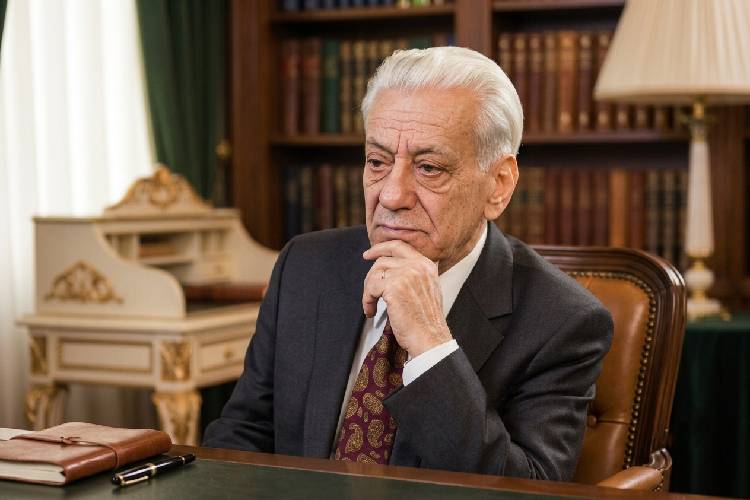 Bakhtiyar Mahmud oghlu Vahabzadeh was born on August 16, 1925, in the city of Shaki to a working-class family. In 1934, he moved to Baku with his family. After completing his secondary education there, he enrolled in the Philology Department of Azerbaijan State University in 1942. He graduated from the university in 1947. He continued his education in postgraduate studies, completing them in 1950.
In 1951, he defended his candidate dissertation on "The Lyrics of Samad Vurghun," and in 1964, his doctoral dissertation on "The Life and Work of Samad Vurghun." Beginning in 1950, he served as a lecturer, associate professor, and professor at Azerbaijan State University, playing a significant role in the training of personnel in modern Azerbaijani literature. He retired in 1990.
His literary endeavors began in 1943 with the publication of his first poem, “Ana və şəkil” ("Mother and Picture"). Subsequently, his poems and scholarly and literary-critical articles were regularly published in periodicals. His first book, “Mənim dostlarım” ("My Friends"), reflects the moral and psychological state of the people who triumphed over fascism, depicted lyrically.
Bakhtiyar Vahabzadeh's creative work is characterized by the strengthening of the civic stance and the development of philosophical lyricism in Azerbaijani poetry. His poems and epics extensively explore themes such as humanity and time, moral values, national identity, and social responsibility. A significant work in his oeuvre is the epic poem "Gülüstan" ("Gulustan"), written in 1958. This piece artistically synthesizes the historical fragmentation of Azerbaijan and its national destiny.
The poet's dramatic works were also prolific. Plays such as “İkinci səs” ("Second Voice"), “Vicdan” ("Conscience"), “Yağışdan sonra” ("After the Rain"), “Yollara iz düşür” ("Traces are Left on the Roads"), “Fəryad” ("Scream"), “Hara gedir bu dünya?” ("Where is This World Going?"), “Özümüzü kəsən qılınc” ("The Sword That Cuts Ourselves"), “Cəzasız günah” ("Unpunished Sin"), “Dar ağacı” ("The Gallows"), and “Rəqabət” ("Competition") were successfully staged for many years on the Azerbaijani theater stage. These works reflect the social and moral problems of modern society, the inner world of man, and social relations in a generalized artistic form.
Bakhtiyar Vahabzadeh made significant contributions to Azerbaijani science, not only as a poet and playwright but also as a research scholar. His investigations into classical and contemporary Azerbaijani literature, as well as oral folk literature, were met with considerable interest from the academic community. Preserving the purity and richness of the Azerbaijani language was a primary focus of his creative work.
Bakhtiyar Vahabzadeh's academic and literary legacy is substantial. He authored over 70 poetry collections, 2 monographs, 11 academic-journalistic works, and hundreds of articles. Additionally, he is recognized as the author of more than 20 extensive narrative poems, covering historical and contemporary themes. His works have been translated into numerous foreign languages and disseminated across a wide geographical area.
The poet's socio-political activities are also noteworthy. In 1980, he was elected a corresponding member of the Azerbaijan National Academy of Sciences, and in 2000, he became a full member. In 1981, at the VII Congress of USSR Writers, he became a member of the Board of the Union of Writers of the USSR. In subsequent years, he was represented on the board of the Union of Writers of Azerbaijan and the Council of Elders. He served as a deputy of the Azerbaijan Supreme Soviet and the Milli Majlis of the Republic of Azerbaijan in various convocations.
Bakhtiyar Vahabzadeh actively advocated for national liberation ideas. His work prominently features the ideology of Azerbaijanism and national self-awareness as leading themes. The poem “Şəhidlər” ("Martyrs"), dedicated to the January 20 tragedy, is particularly significant in this regard.
His literary, scholarly, and public activities were highly appreciated, and he was awarded the "Istiglal" Order, one of the Republic of Azerbaijan's highest state awards.
Bakhtiyar Vahabzadeh died in Baku on February 13, 2009. His multifaceted work represents an important stage in the development of Azerbaijani literature and plays a significant role in shaping national cultural memory.
Recommended literature:
- Mirzəyeva, Aida Ramiz qızı. Azərbaycan istiqlal poeziyası: Bəxtiyar Vahabzadənin yaradıcılığı fonunda : monoqrafiya / A. Mirzəyeva ; Beynəlxalq Avrasiya Mətbuat Fondu. - İstanbul : Arab History Publishing, 2023. - 214 s.
- Alməmmədova, Səbinə Məmməd qızı. Bəxtiyar Vahabzadə poeziyasının dili : monoqrafiya / S. M. Alməmmədova ; elmi red. V. M. Arzumanlı. - Bakı : Elm, 2010. - 163 s.
- Hikmət mücrüsü / tərt. F. Əsgərov ; red.: V. Aslan, N. Mustafa. - Bakı : Zərdabi Nəşr MMC, 2025. - 624 s.
- Nəbibəyli, Ziyadxan İsrafil oğlu. Bəxtiyar Vahabzadənin milli-mənəvi portreti / Z. İ. Nəbibəyli ; baş red., ön sözün müəl. T. Ə. Əhmədov ; red. İ. Məmmədli. - Bakı : Ecoprint, 2022. - 164 s.