
World-famous singer Rashid Behbudov
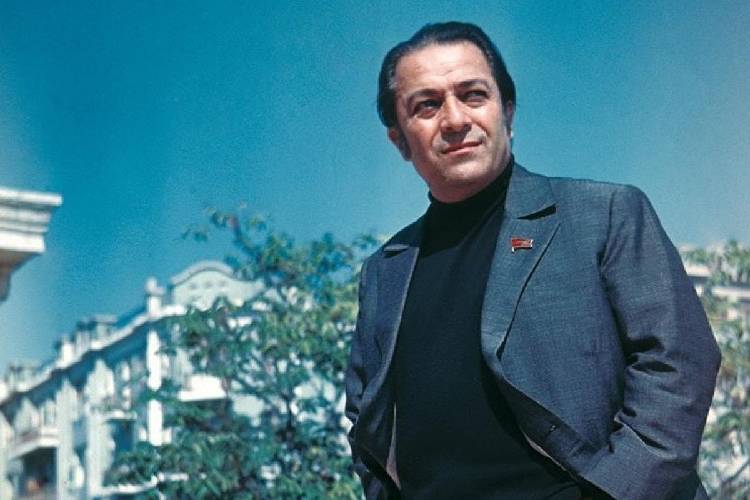 The prominent Azerbaijani singer and public figure Rashid Behbudov was born on December 14, 1915, in Tiflis, in the family of the khananda (mugham singer) Majid Behbudali oglu. Originally from Shusha, Majid Behbudov was among the renowned performers of Azerbaijani mugham and a distinguished figure of his time. His mother, Firuza Abbasgulu gizi Vekilova, a representative of the well-known Vekilov family from Gazakh, taught Russian language in Tbilisi schools until the end of her life.
After graduating from school in 1933, Rashid Behbudov made his first stage appearance at the “Müstaid” summer concert held in a Tbilisi Park. The Azerbaijani folk songs he performed with the accompaniment of an instrumental ensemble were received with great admiration by the audience. This successful debut marked the beginning of his artistic career. That same year, he entered the Railway Technical College, where he formed an independent student orchestra and performed as its soloist. During his military service, Behbudov was a soloist of the army ensemble and later continued his career in Tbilisi as the soloist of one of the city’s estrada groups.
From a young age, Behbudov was well-known and admired throughout the South Caucasus. During a tour to Baku, his performance of excerpts from Uzeyir Hajibeyli’s operetta “Arşın mal alan” (The Cloth Peddler) attracted the attention of a stage director, who was impressed by his interpretation. It was precisely this performance that led to his invitation to play the role of Asgar in the film “Arşın mal alan”. Filmed at the Baku Film Studio in 1943 and based on Uzeyir Hajibeyli’s operetta of the same name, the movie was released in 1945 and quickly gained enormous popularity not only in Azerbaijan but throughout the entire Soviet Union. Rashid Behbudov’s portrayal of Asgar brought him international fame, and in 1946, he was awarded the Stalin Prize for this role.
Rashid Behbudov’s creative career was remarkably rich and multifaceted. Possessing a powerful vocal timbre and a wide vocal range, his singing blended both professional and folk music traditions. The songs of Tofig Guliyev held a special place in his repertoire. Works such as “Azərbaycan” (Azerbaijan), “Neftçinin mahnısı” (The Song of the Oilman), and “Züleyxa” (Zuleykha) found a deep connection with the public through Behbudov’s interpretation, becoming beloved pieces among music enthusiasts. He also masterfully performed Fikrat Amirov’s songs and romances — including “Gülüsh,” (Smile), “Ulduz” (Star) and “Sevdiyim yardır” (She is my beloved) — granting them enduring life within the treasury of Azerbaijani music.
From 1946 onward, Behbudov worked at the Azerbaijan State Philharmonic named after M. Magomayev. Between 1953 and 1960, he also performed intermittently at the Azerbaijan State Opera and Ballet Theatre named after M. F. Akhundzade. He created the role of Balash in the opera “Sevil” and appeared in the documentary film “To My Native People”. Beginning in 1957, he continued his artistic activity with the State Concert Ensemble under the Azerbaijan State Philharmonic. In 1968, he founded the first Song Theatre in the republic, serving as its artistic director and soloist until the end of his life.
Rashid Behbudov’s performing style shaped a new stage in the development of the Azerbaijani vocal school. His voice resonated across many countries and played a vital role in promoting Azerbaijani music worldwide. The singer toured Bulgaria, Poland, Hungary, Finland, the United Kingdom, the Netherlands, France, Italy, Austria, Türkiye, Iran, India, Egypt, Syria, Ethiopia, and many other countries, performing songs in more than 50 languages and bringing Azerbaijan’s music to the world.
The songs performed by Behbudov in the film “Bakhtiyar” — including “Golden Ring,” “Zibeyda,” “The First Love Song,” “The Song of Love,” and “The Song of Friendship” — have become classics of Azerbaijani vocal art. His performances were always distinguished by sincerity, refined taste, and exceptional mastery.
The artist’s extensive creative legacy was recognized with numerous high state honors. Rashid Behbudov was a laureate of both the USSR and the Azerbaijan State Prizes and received the Orders of Lenin, the Red Banner of Labour, and the Order of Friendship of Peoples, along with several high awards from foreign countries. He was granted the honorary titles of People’s Artist of Dagestan and Honored Art Worker of Georgia, was named People’s Artist of the USSR in 1959, and was awarded the title Hero of Socialist Labour in 1980.
The world-renowned singer and vocal master Rashid Behbudov passed away on June 9, 1989, in Moscow, and was laid to rest in the Alley of Honor in Baku. He remains forever remembered as one of the brightest figures of Azerbaijani musical culture, and the performing school he established continues to serve as an enduring model for new generations of performers.
Recommended literature:
- Nəsirova, Könül. Rəşid Behbudov / K. Nəsirova. - Bakı : Şərq-Qərb, 2017. - 152 s.
- Rəhmanzadə, Fazil Şamil oğlu. Rəşid var olan yerdə... : böyükdən böyük müğənni barədə hekayətlər / F. Ş. Rəhmanzadə ; red., ön sözün müəl. R. B. Hüseynov ; layihənin rəh. Ş. Rəhmanzadə. - Bakı : Apostrof, 2018. - 556 s.
- Son bahar: [Müsahibə və xatirələr] /tərt. və red. C. Cəfərov ; naşir M. Xan ; dizayner F. İlham. - Bakı: Mücrü, 2022. - 110 s.
- Абасова, Эльмира Абдулгамид кызы. Рашид Бейбутов/Э. Абасова; ред. Д. Данилов. - Баку: Азернешр, 1965. - 67 с.