
People’s Poet of Azerbaijan, literary scholar and translator Balash Azeroglu
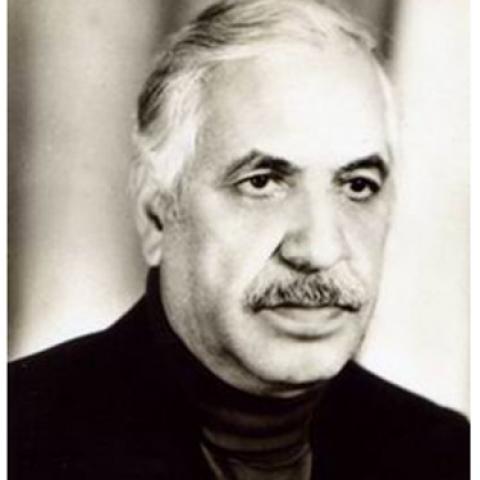 People’s Poet of Azerbaijan, renowned playwright, literary critic, and translator, Balash Allahbakhish oglu Abizadeh was born on November 11, 1921, in Baku. His parents were originally from the village of Salim Qishlaghi in Ardabil, Southern Azerbaijan. He received his secondary education at School No. 21 in Baku, where he developed a keen interest in literature. His literature teacher, Jafar Ramzi, had a profound influence on him. While still a student, he joined the literary circle at the Republican House of Pioneers, and in 1936 his first published poem, “Dnepr”, appeared in Baku.
In 1937, during the wave of repression sweeping across the country, Balash Azeroglu and his family were exiled to Ardabil in Southern Azerbaijan. There, he began attending night courses to learn Persian. At an early age, he joined the national liberation movement, becoming a member of the People’s Party of Iran in 1942. Actively participating in anti-monarchist demonstrations organized by the party, he wrote poems under the pen name “Azeroglu,” calling the people to freedom. In 1943, he was elected chairman of the Ardabil Committee of the Anti-Fascist Organization, and in 1945 became a member of the Azerbaijani Democratic Party (ADP). Between 1945–1946, he served as editor of “Jovdat”, the newspaper of the ADP’s Ardabil Regional Committee, deputy chairman of the Tabriz Radio Committee, and also a deputy of the Azerbaijani National Assembly.
In 1946, the National Government of Azerbaijan (NGA) collapsed. On December 14, 1946, the Iranian army, backed by the United States and the United Kingdom, entered Tabriz. However, the massacres and deportations continued afterward, claiming the lives of thousands. Among those killed were members of the Azerbaijan Democratic Party (ADP), fedais (freedom fighters), as well as prominent poets such as Ali Fitrat, Sadi Yuzbendi, Jafar Kashif, and Mohammad Baqir Niknam. Balash Azeroghlu was forced to go into hiding in Tabriz for a period. On April 15, 1947, he was secretly evacuated from Tabriz to Baku by the “Nijat Society,” an underground organization created to rescue democrats hiding in Southern Azerbaijan. The “Society of Poets and Writers,” which had been active in Tabriz during the NGA period, began operating in Baku in 1947 under the name “Azerbaijan Writers’ Society.” Balaş Azeroghlu was elected chairman of the society. That same year, he began his studies at the Faculty of Philology at Azerbaijan State University. In 1950, he married Madina Gulgun, and the couple had two sons named Araz and Etibar.
From 1947, as chairman of the Southern Azerbaijani Writers’ Society, Balash Azeroglu also served as editor of the “Azerbaijan” newspaper, the organ of the ADP Central Committee (1954–1955), and later, between 1956–1964, as head of the propaganda department and deputy chairman of the ADP Central Committee.
From 1963 to 1982, Balash Azeroglu was a researcher at the Nizami Institute of Literature of the Azerbaijan Academy of Sciences, and from 1981–1991, he served as secretary of the Board of the Writers’ Union of Azerbaijan. In 1981, he was awarded the honorary title of “People’s Poet of Azerbaijan.” From 1991 until the end of his life, he worked at the Writers’ Union of Azerbaijan as chief adviser on Southern Azerbaijani literature. Following the restoration of Azerbaijan’s independence, he was awarded the “Shohrat” Order and was also a recipient of the President’s personal pension.
Balash Azeroglu, remembered as one of the prominent figures of modern Azerbaijani poetry, published more than forty books in various genres. The central motifs of his works are patriotism, national awakening, and the struggle for freedom. His translations from Persian—such as Nizami’s “Seven Beauties”, Fuzuli’s ghazals, and works by Shahriyar—were highly esteemed by readers. His poetry collections, including “Poems”, “Savalan”, “On the Roads of Struggle”, “My Friends of Youth”, “My Songs”, “Morning Dawns”, “The Power of Art”, “At Hafiz’s Grave”, “The Homeland Wants Such a Son”, “My Yesterday, Today, and Tomorrow”, “Come, O Spring”, “My Chest Is Mount Savalan”, and “I Need a Rostrum”, won him wide popularity.
For his literary and public service, he was twice awarded honorary diplomas of the Presidium of the Supreme Soviet of the Azerbaijan SSR, and decorated with the medals “Friendship of Peoples,” “21 Azer,” “On the Occasion of the 100th Anniversary of Vladimir Ilyich Lenin,” as well as the Orders of “Badge of Honor” and “Shohrat.”
The beloved People’s Poet and public figure Balash Azeroglu passed away in Baku on April 24, 2011, and was laid to rest in the Second Alley of Honor.
Recommended literature:
- Əliqızı, Almaz. Cənubi Azərbaycan ədəbiyyatı məsələləri / A. Əliqızı ; elmi red. C. Abdullayev. - Bakı : Azərnəşr, 2007. - 268 s.
- Azəroğlu, Balaş. Seçilmiş əsərləri / B. Azəroğlu ; bur. məsul Ə. Güləliyev. - Təkrar nəşr. - Bakı : Öndər nəşriyyat, 2004. - 288 s.
- Güney Azərbaycanın iki xalq şairi: Balaş Azəroğlu və Qulamrza Səbri Təbrizi: [seirlər] / tərt.-red. V. S. Sultanlı. - Bakı : Azərnəşr, 2010. - 264 s.