
Prominent composer of Azerbaijan, Afrasiyab Badalbeyli
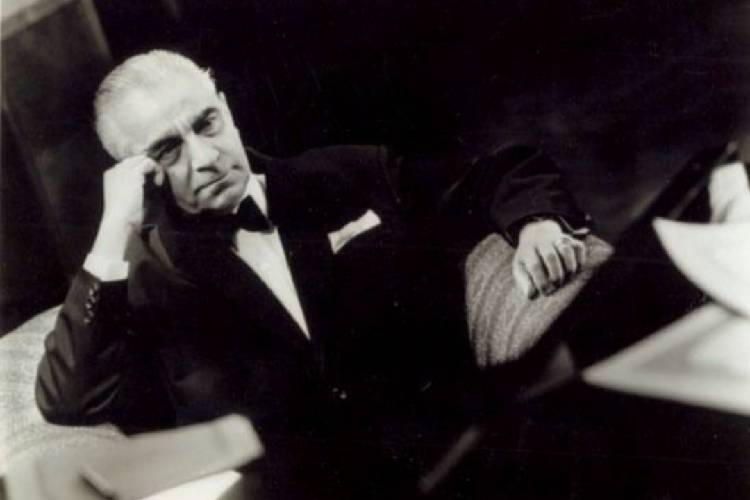 Afrasiyab Badalbeyli was born on April 19, 1907, in the family of the national enlightener Badalbey Badalbeyov in the city of Baku. His father, who dedicated his life to the cause of popular education, came from a hereditary noble family of Karabakh ancestry. His mother, Rahima Khanim, was the representative of Shah Qajar’s well-known genes.
In 1912, Afrasiyab Badalbeyli went to Russian-Muslim school № 6, and in 1916, he left graduated the school with distinction.
Between 1917 and 1924, he continued his education at the 1st Real School in Baku. From 1923 to 1926, Afrasiyab Badalbeyli was a student at the Azerbaijan Theater School and eagerly participated in theater performances organized by fellow students.
The 20th century was a pivotal period in the history of Azerbaijan music culture. During this time, in the quest for new ways, there was a tendency to denounce national operas and operettas created in the early 20th century. At that time, 17-year-old Afrasiyab Badalbeyli published an article in the "Communist" newspaper, arguing against this negative reformist tendency.
In 1924, with the aim of improving his education, Afrasiyab Badalbeyli entered the Azerbaijan State Turk Music Training College and simultaneously studied at the Azerbaijan State University in the linguistics department of the East faculty.
In Music College he pursued a profession of violin in S.L. Bretanitski's class. The talented young musician was soon notable for his mastery.
On May 22, 1925, the College students directed Uzeyir Hajibeyov's operetta "Arshin Mal Alan", where Afrasiyab Badalbeyli participated in the orchestra as a concertmaster of the second violins.
Besides the violin, A. Badalbeyli perfectly mastered the national instrument tar, and in 1926 he participated in the orchestra of folk instruments as a concertmaster of the second tar players, as well as in tour concerts in Moscow and Minsk.
Premiere of the drama "Fiancée of a Flame" by J.Jabbarli was staged on February 16, 1928. Afrasiyab Badalbeyli was the author of the music to this spectacle.
Inspired by the success of the performance, J.Jabbarli authorized A. Badalbeyli's composition of music for his next work, "Sevil".
Since January 1, 1928, A.Badalbeyli had started working as a translator in the newspaper "Communist".
In 1929, a campaign against the popular musical instrument named “tar” began with the objective of excluding it from the conservatory’s curriculum due to outdated traditions. Strongly protesting against all this, Afrasiyab Badalbeyli wrote an article titled “Regarding the trial of the tar”.
In 1930, during the celebration days of the 10th anniversary of Soviet authority establishment in Azerbaijan, the first tone poem "28 Aprel March" and the suite "All the authority to the Soviets!" by Afrasiyab Badalbeyli were the first program works in Azerbaijani music devoted to the Soviet subject.
On May 15, 1930, A.Badalbeyli began working as a conductor of Turko operas at the M.F.Akhundov Theatre of Opera and Ballet.
In 1931, A.Badalbeyli composed music to plays by J.Jabbarli, including "Almaz", "In 1905", "Yashar". Extending his activity in the field of theatre, he also wrote music to the spectacles "Fear" by A.Afinogenov (1933), "Haji Gara" (1934), and "Monsieur Jordan" (1935) by M.F.Akhundov.
In 1932, A.Badalbeyli entered the Moscow Conservatoire. Here he studied at the conducting faculty in Professor K.Sarajev's class. During his studies at the conservatory, he is also engaged in composition. The works of this period include 8 variations, a sonatina for cello and piano, a suite for a symphony orchestra, and a string quartet. However, after a year Afrasiyab Badalbeyli, having left his studies, returns to Baku and participates in the staging of the opera “Shahsenem” by R. Glier in a new version, with a libretto by J. Jabbarli.
In the autumn of 1934, A.Badalbeyli went to Leningrad (now St. Petersburg) and entered the Music Training College attached to Leningrad State Conservatoire named after Rimski-Korsakov. Here he studied in the composer's department in Professor B. Zeydman's class. At the same time, he started working as an assistant conductor under the direction of the Principal Conductor of the V.Dranishnikov Theatre of Opera and Ballet in Leningrad.
In 1938, having successfully finished his studies in Leningrad, A.Badalbeyli returned to his motherland. In the same year, he composed an act ballet-tale "Tarlan" to the libretto of his brother Turgud Badalbeyli.
The day of April 8, 1940 became history of Azerbaijani musical culture as a day of creation of the first national ballet. This day the premiere of the ballet "Maiden Tower" by A.Badalbeyli was staged at the Azerbaijan State Theatre of Opera and Ballet named after M.F.Akhundov.
On April 23, 1940, A.Badalbeyli was awarded the honorary title "Honoured Art Worker" of the Republic for prominent services in the field of art.
In 1941, A.Badalbeyli, in association with B.Zeydman, created the one-act opera "People's Wrath" (authors of the libretto: I.Gratovski and A.Mamedkhanli).
These years were marked by music with plays "Farhad and Shirin" and "Khanlar" by Samed Vurghun. He was a conductor of these productions, as well. A.Badalbeyli's wartime activity as a composer and conductor was combined with his occupation of the positions of Director and Art Director of the Azerbaijan State Philharmonic. In association with M.S. Ordubadi, A.Badalbeyli translated into Azerbaijani the text of the opera "Barber of Seville" by J.Rossini, the Italian composer. He wrote the libretto for the new edition of the ballet "Don Quixote" by Minkus.
The postwar years were marked by the 800-year jubilee of the great Azerbaijan poet Nizami Ganjavi. Preparation for this date began as early as 1939, and A.Badalbeyli was commissioned to create the opera about the poet's life. But this plan was interrupted by a war. Only on December 12, 1948, was the first staging of the opera "Nizami".
In these years, A.Badalbeyli also led the musical editorship of the Azerbaijan Radio Committee.
In the first half of 1950th there was a considerable upsurge of creative effort at the Theatre of Opera and Ballet. Three significant works by Azerbaijan composers were staged during this short period. They were ballets "Gulshan" by Sultan Hajibeyov (1951), "Seven Beauties" by Gara Garayev (1952), and the opera "Sevil" by Fikret Amirov (1953). Production of the ballet "Gulshen" and opera "Sevil" was connected with A. Badalbeyli's name, because he was the conductor of these spectacles.
A.Badalbeyli was admitted not only as a musician, but also as a litterateur and linguist. He took an active part in working up and the admission of the Azerbaijan Language orthography by the reformatory committee of the Literature Institute named after Nizami of the Azerbaijan Academy of Sciences in 1952. In the same year, he brought into play the eurhythmic congruence of P.Chaikovski's "Iolanta" opera text from Russian into Azerbaijani.
The first brochure by A.Badalbeyli's "Talk about music", where the author explains some music terms, tells about musical genres and forms, musical instruments and ensembles, came off the press in 1953. It was the first of such a sort. (In 1958, the brochure "To know and to love music" by D.Shostakovich, in 1962- "Function of music and its capabilities" by I.Rijkin came to hand).
In 1954, "Sinfonietta" for the folk instruments orchestra by A.Badalbeyli was performed at the 7th plenum of the Composers' Union of Azerbaijan.
In 1955 there was published his monograph "Gurban Primov" was published about a well-known tar player, who had been the disciple of the traditions of Azerbaijan tar reformer Mirza Sadig Asad oghlu and opened a new mark in the history of the national performing art in Gurban Primov's mastery.
Afrasiyab Badalbeyli paid much attention to matters of terminology. Considering the traditionally used terms of Russian and foreign origin in Azerbaijani music, A.Badalbeyli tried populating them among Azerbaijani inhabitants, explaining, decoding, and thus promoting enrichment of the native language. With this purpose, his "Dictionary of music terms" came off in 1956.
In 1957, A.Badalbeyli wrote the libretto for the ballet "Golden Key" by B. Zeydman.
In 1959 he took an active part at the decade of Azerbaijani music culture and art in Moscow. His ballet "Maiden Tower" was shown within the framework of the decade. It was enthusiastically accepted by all music public of Moscow, many approving responses came into sight in Moscow press.
1960 was a significant year in the life of Afrasiyab Badalbeyli, as on May 24, 1960, by the decree of the Presidium of the Supreme Soviet of the Azerbaijan SSR, the composer was honored with the title of People’s Artist of the Republic.
In 1962, the opera "Daisi" by Zakhariya Paliashvily, the Georgian composer, was staged in the Azerbaijani language at the Theatre of Opera and Ballet in connection with tours to Georgia. The translation of it belonged to A. Badalbeyli.
In 1964 - 1965 years A.Badalbeyli, as a jury chairman, took an active part in organization and conducting of the XVIII-th and XIX-th Republican Olympiads of youth collectives of amateur performances.
In 1965, A.Badalbeyli, in association with Gamar Almaszadeh, wrote the libretto of the ballet "Black girl" by Ashraf Abbasov, on S.S.Akhundov's motives of the same story.
In 1968, A. Badalbeyli, together with Turgud Badalbeyli, created the libretto of the opera "Aydin" by Ramiz Mustafayev on J.Jabbarli's drama of the same name.
Afrasiyab Badalbeyli's book "Explanatory-Monographic Music Dictionary" came off the press in 1969.
In 1970, a conference of the International Society for Music Education of Children and Youth was held in Moscow under the slogan “The Role of Music in the Lives of Children, Youth, and Adolescents”. The delegation from Azerbaijan, led by Afrasiyab Badalbeyli, participated in the conference’s proceedings.
In 1971, A.Badalbeyli was elected chairman of the Choral Society.
Afrasiyab Badalbeyli was a member of the editorial board of the journal “Science and Life” and the newspaper “Literature and Art” for many years, and he appeared in the pages of the republic’s periodical press with reviews, critical, and problematic articles.
Afrasiyab Badalbeyli passed away on January 9, 1976 in Baku.
Recommended literature:
- İsmayılzadə, Nuridə Cəfər qızı. Böyük maarifçi - Əfrasiyab Bədəlbəyli : radio və televiziya verlişləri: dərs vəsaiti / N. C. İsmayılzadə ; elmi red. G. A. Abdullazdə ; Üzeyir Hacıbəyli adına Bakı Musiqi Akademiyası. - Bakı : Elm və təhsil, 2017. - 188 s.
- Paşayeva, Yaqut Süleyman qızı. Əfrasiyab Bədəlbəyli və Azərbaycan xalq musiqisi / Y. S. Paşayeva ; elmi red. T. Məsimov. - Bakı : Nurlan, 2002. - 265 s.
- Quliyev, İbrahim Hacıbaba oğlu. Maestro / İ. H. Quliyev ; elmi red. Ə. İ. İsazadə ; Heydər Əliyev Fondu. - Bakı : CBS Polygraphic Production, 2008. - 184 s.